
Buying a luxury flat in Geneva: what is the current state of the market?
Buying a luxury flat in Geneva: what is the current state of the market?
Switzerland, and more specifically the canton of Geneva, holds a special place in the luxury property market. Following a few mixed years, the sector is now experiencing strong growth. This resilience can be attributed, in part, to the impact of the pandemic and the desire to refocus on the home, now regarded as a key element of well-being. Interest from overseas buyers in luxury property in the canton has also contributed to the sector’s success. High property prices and rising mortgage rates are not deterring buyers.
Recent years have been characterised by a clear desire to become homeowners. The luxury sector has benefited particularly from this trend. In its 2021 annual report on luxury property, UBS noted: “In 2020, rising demand in the luxury segment drove prices up by 9 per cent – significantly more than the 4.4 per cent average recorded in the Swiss owner-occupied housing market.”
Also for the same year, “the number of transactions rose by more than half compared with the previous year. It is thus roughly three times its five-year average.”
The pandemic acted as a catalyst. The market benefited from the positive performance of the financial markets in 2021 and from the pandemic. Against a backdrop of crisis, luxury property served as a safe haven.
Swiss household spending fell significantly during lockdown, encouraging the purchase of property.
Demand from abroad also boosted the sector. Health measures in Switzerland, which were less restrictive than in other European countries, encouraged potential buyers to take the plunge.
High demand in Geneva
In Geneva, the luxury property market is very buoyant. In 2020, 96 luxury transactions were recorded in the canton. The market’s excellent health continued into 2021. The year ended on a record high: the number of transactions rose by 48 per cent to 208, whilst the total value, across all property types, increased by 20 per cent to 4.97 billion francs.
Prices for properties in Switzerland’s most sought-after locations, including Geneva and its surroundings, rose by around 10 per cent compared with 2020.

Ms Magali Tschannen, who works in the Sales department at Moser Vernet & Cie, notes: “Sales remain strong, despite a limited supply. The rise in mortgage rates and the uncertainties surrounding the war in Ukraine have not, for the time being, had any real impact on the market.”
This analysis is shared by the property research firm CIFI. “The latest rise in property values shows that mortgage conditions have so far had only a limited influence on demand.” Indeed, currency depreciation and market uncertainties are driving a desire to convert capital into tangible assets such as property.
The neighbourhood: a key factor
Location is the main deciding factor, particularly in the luxury property sector, where it plays a major role in determining a property’s value.
In Geneva, despite the city’s reorganisation brought about by the creation of new neighbourhoods, demand for luxury properties continues to be concentrated in certain specific areas on the left bank.
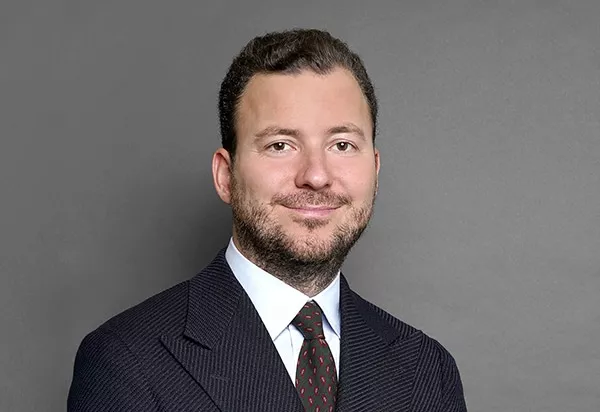
Mr Nicolas Teissier, an estate agent at Moser Vernet & Cie, notes: “In the city, the Champel neighbourhood remains highly sought-after, whilst in the countryside, Vésenaz offers all the amenities of a town centre on a human scale.”
Neighbourhoods in the heart of Geneva, such as the Old Town, are also attracting strong interest from buyers, as is the municipality of Cologny, which remains the most expensive on the Swiss luxury property market. Proximity to the lake remains an important factor for a prestigious flat, as does the view.
A desire for something new
Apart from its price, the very definition of what constitutes a luxury flat remains subjective. However, there are certain features common to prestigious properties. For example, the building – whether old or new – must feature distinctive architecture. An unobstructed view of the lake, the mountains or the vineyards is an essential criterion. This serves both the owner’s aesthetic pleasure and the need to preserve the privacy of their home. Apartments with character – exposed beams, mouldings, etc. – regardless of their size, also fall within the luxury segment. A 70-square-metre duplex can thus be categorised alongside a 200-square-metre flat with a terrace.
By imposing a new way of living at home, lockdown has profoundly changed the expectations of prospective owners regarding their flats. New-build properties are therefore in high demand.
Ms Magali Tschannen observes: ‘New-build properties offer layouts better suited to demand. Prospective owners want open-plan spaces, particularly in the living room. This space must allow for interaction and sharing with family and friends.”
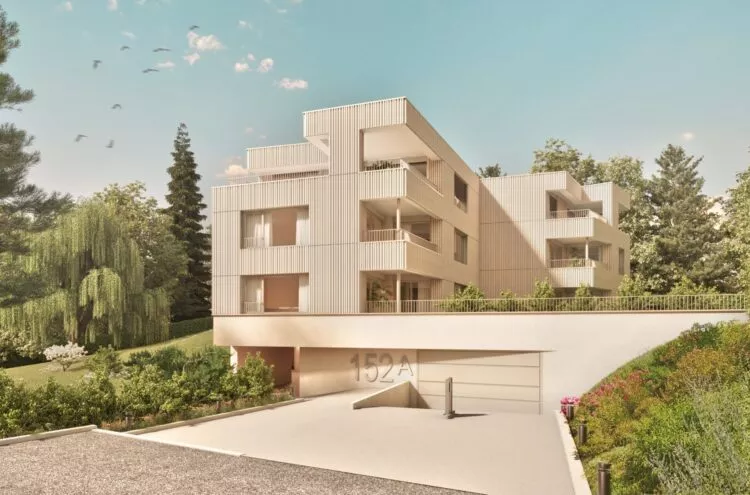
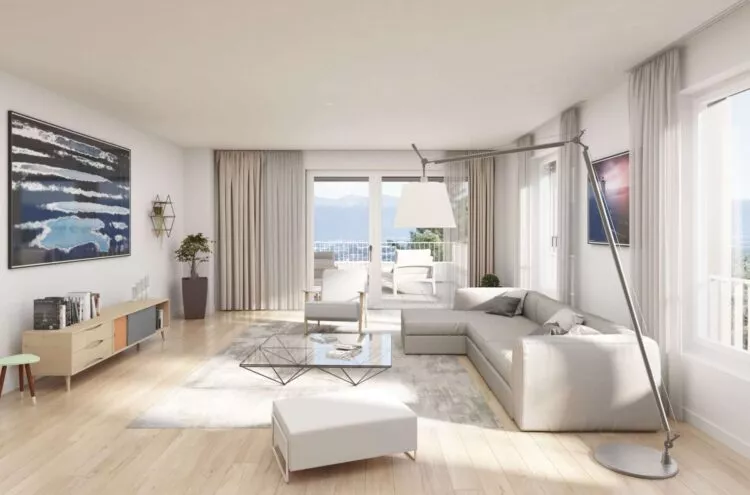
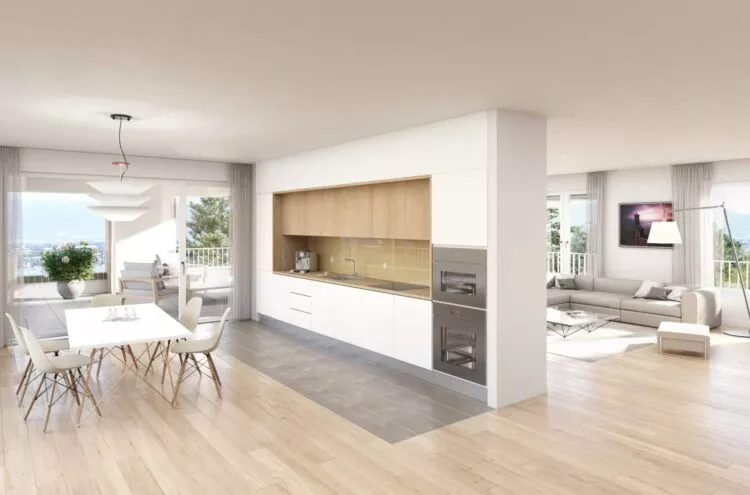
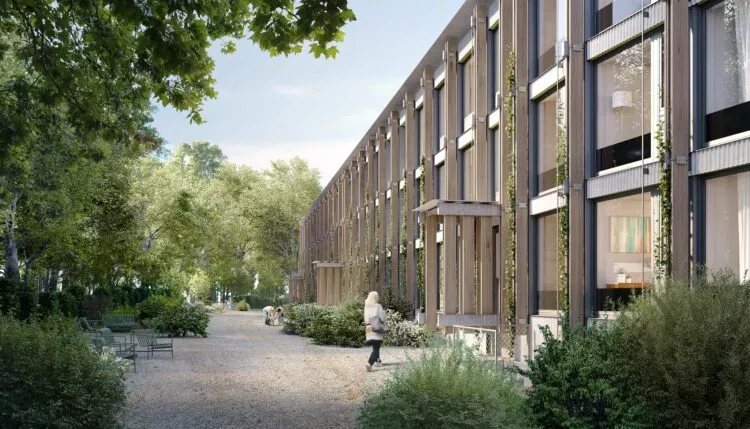
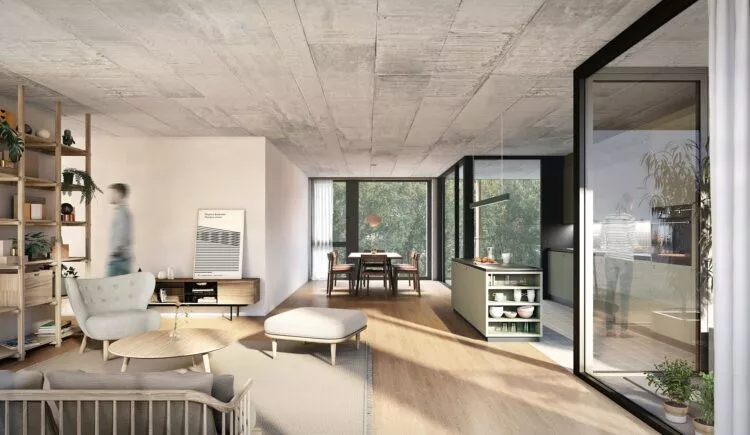
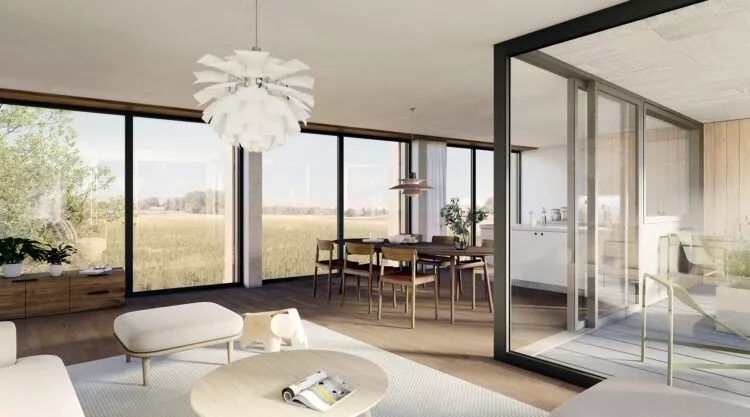
There is also a focus on practicality. Built-in storage is in high demand, and buyers are even prepared to sacrifice a few square metres of kitchen or bedroom space for it.
Another essential feature: the bathrooms. There must be at least two of them – one for the master bedroom, the other for the other bedrooms – fitted with a walk-in shower and a bath. In the kitchen, a central island is now a standard feature of luxury properties.
The quality of the finishes is also becoming increasingly important.
Nicolas Teissier notes: ‘Buyers are increasingly discerning about the materials used and are willing to pay a premium for a property if it perfectly meets their expectations.’
Older flats are also in demand. But only provided they have been renovated. Indeed, prospective owners now want to move straight into a property that’s ready to move into. They are less inclined to buy a flat that requires work. The kitchen and bathrooms must be top-of-the-range.
Mr Nicolas Teissier also highlights a new concern: “These days, potential buyers of a flat in a block of flats ask for the property’s energy performance certificate before making a decision.”
A real breath of fresh air
The desire to have a balcony, a terrace or a garden has been amplified by the pandemic. Having an outdoor space has become the new hallmark of a luxury property. Whatever the size of this outdoor area, it acts as an extra room and adds significant value. This outdoor space enhances the property’s value and makes it easier to sell.
The property’s location also plays a part in this increased value. This will be more pronounced in municipalities such as Cologny, Collonge-Bellerive or Vandoeuvres, and will depend on whether or not the property is close to the lake.
In Geneva, townhouse-style properties with a small garden are highly sought-after, as are penthouse flats with a large terrace. However, properties of this type remain rare in older buildings located in the city centre.
Potential buyers are therefore turning to new-build properties where outdoor spaces are generous.
Landscaping the space and fitting it out with, for example, a bioclimatic pergola represents an attractive added value for a buyer.
Geneva’s luxury property market also features a few unusual properties.
Magali Tschannen: “Genuine lofts are very rare. Unlike major cities such as New York, Geneva has not converted its old industrial buildings into housing. There is a wider range of duplex flats on offer, although demand for this type of property is not the norm. A family with young children would be hesitant. Furthermore, the bedrooms must be on the upper floor to appeal to potential buyers.”
Buyers from the local area and further afield
Demand is being driven by foreign buyers, attracted by the economic and political stability in an uncertain international climate. These buyers have focused on ultra-luxury properties.
Swiss and foreign clients already resident in the country are also active in the market. However, UBS expects a slowdown in domestic demand for luxury property.
The average age of buyers of luxury flats is around 40. However, as Magali Tschannen points out, ‘the profiles are very varied. There are also young couples and many blended families.”
The behaviour of potential buyers has also changed. The sense of urgency that characterised the immediate post-Covid period has subsided. The desire is still there, but potential buyers are taking their time.
This attitude may be explained by a study from the Federal Office for Housing (OFL). Indeed, the majority of people looking for a property wish to spend the rest of their lives there, with around 20 per cent of them hoping to stay for more than ten years.
The facts set out above demonstrate that Geneva remains a highly attractive city for luxury property. Moser Vernet & Cie SA is active in this market, handling both lettings and sales. Ms Magali Tschannen and Mr Nicolas Teissier, estate agents with the firm, and their team are on hand to advise you if you are looking to sell or purchase a property.
The sales department is here to help
ventes@moservernet.ch | +4122 839 09 47